
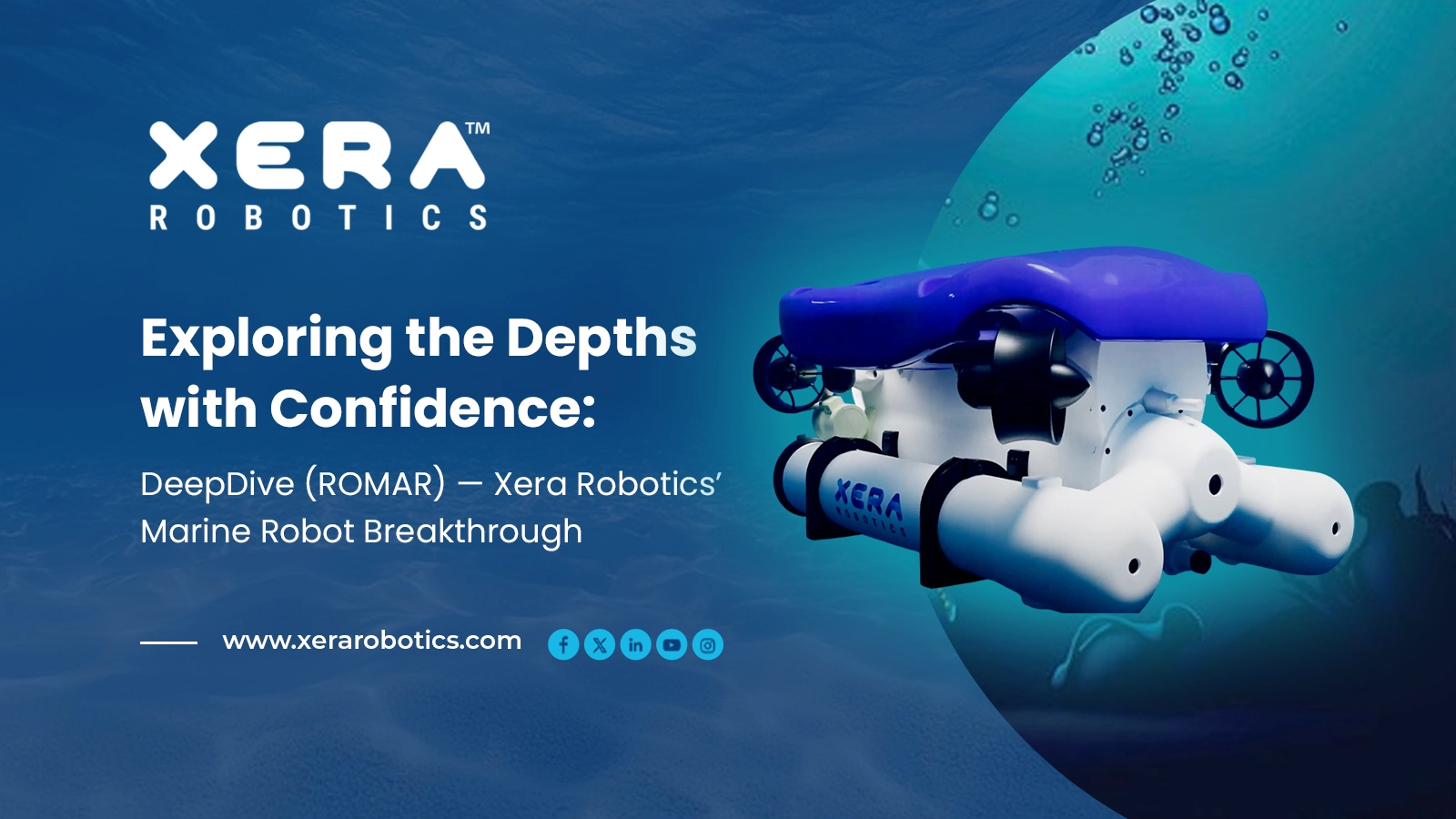
Underwater environments are some of the most challenging—opaque visibility, strong currents, corrosion, pressure, obstacles, and the constant threat to human divers. That’s where Xera Robotics introduces the DeepDive series, powered by ROMAR (Remotely Operated Marine Robot). Designed to bring together robustness, flexibility, and precision, ROMAR is engineered for a wide spectrum of underwater missions—from infrastructure inspection to scientific exploration.
What is DeepDive (ROMAR)?
DeepDive (ROMAR) is a modular, high-performance marine robot platform. It is remotely operated, designed to handle challenging submerged environments safely and efficiently. The key features include:
- Modular Platform: Whether it's inspection, manipulation, sampling, imaging, or maintenance, you can swap in modules as per the mission requirement.
- Position Hold: The ability to hold position precisely underwater is critical for detailed imaging, mapping, or intervention tasks.
- Obstacle Avoidance: ROMAR is equipped with advanced sensors and navigation systems that detect obstacles and adapt course to prevent collisions.
- 360° Rotation: Full rotational maneuverability gives comprehensive coverage for inspections, imaging, and surveying without having to reposition the whole vehicle or tether.
Why These Features Matter
1. Modularity = Versatility
Different underwater tasks have different demands. A coral reef survey needs high-resolution cameras, possibly environmental sensors; an offshore platform inspection needs manipulators, ultrasonic thickness gauges, or NDT (non-destructive testing) tools. A modular platform means fewer specialized robots, less downtime, and more cost-effectiveness.
2. Position Holding for Precision
In water, currents and buoyancy constantly push and pull. Tasks such as detailed inspections, cutting / sealing, or sample collection need the robot to stay steady. Position-hold systems (using e.g., thrusters, control loops, inertial sensors) ensure images and measurements are accurate, and tools are deployed with precision.
3. Obstacle Avoidance = Safety & Mission Continuity
Environmental complexity underwater—rocks, marine growth, debris, structural elements—poses risk. Obstacle detection (e.g. via sonar, LIDAR, optical sensors) prevents damage to the robot or the asset, avoids losing the robot, and reduces mission failures.
4. 360° Rotation = Full Coverage, Better Data
Being able to rotate in every direction makes a big difference for inspection tasks. You can inspect all sides of a pipeline, or get full panoramic images without moving or re-underwater-deploying the robot. It speeds up missions, reduces pivoting or repositioning, and gives more consistent data.
Technical Considerations That Users Should Know
To help customers evaluate if ROMAR is right for them, some technical aspects to clarify (either in blog or product pages) include:
- Depth Rating / Pressure Resistance: What maximum depth can ROMAR safely operate at? How does pressure affect sensors, seals, etc.
- Power & Endurance: Battery life or tether capacity; how long can it hold position and do inspections before needing recharge/servicing.
- Sensor Suite & Payload Options: Cameras (optical, infrared?), sonar, LIDAR, environmental sensors, manipulators; Our resolution, precision.
- Navigation & Control System: How are obstacles detected (type of sensors), how tight is the position-holding, how does it respond in currents?
- Communications: How is live video/data transmission handled underwater (via tether, acoustic modems, fiber optics), latency, reliability.
- Maintenance, Durability & Reliability: Materials, corrosion resistance, maintenance schedule, ease of module swapping.
Why Xera Robotics is the Smart Choice for Your Marine Robot Solution
When you choose Xera Robotics, you're partnering with a company that understands both the promise and the perils of underwater missions. The DeepDive (ROMAR) platform brings together modular design, precision positioning, and advanced sensing—features that translate into real-world reliability. In environments where currents, pressure, and visibility pose serious challenges, we build in systems like precise position-holding and obstacle avoidance so that your mission succeeds without costly delays or risky compromises.
Beyond raw capability, Xera Robotics offers versatility. Whether you need to inspect underwater infrastructure, conduct scientific research, monitor marine environments, or perform maintenance in remote offshore settings, ROMAR’s interchangeable modules make it easy to tailor the robot for your specific task. This adaptability means lower capital cost and faster turnaround: you don’t need separate robots for each type of job, and changing over payloads or tools becomes straightforward.
Finally, choosing Xera Robotics means choosing safety, sustainability, and long-term value. Our engineering emphasises durability and serviceability, combining robust materials and smart control systems that reduce wear, reduce maintenance, and extend operational life. The advanced sensors and systems not only protect the robot and the assets it’s inspecting, but also protect operators from risk. Over time, this means fewer failures, less downtime, and better ROI for your marine robotics investment.
Common Questions About Xera Robotics’ Marine Robot
1. What is ROMAR, and how is it different from other underwater robots?
ROMAR (Remotely Operated Marine Robot) is part of Xera Robotics’ DeepDive series. What sets it apart is its modular platform (you can attach or swap modules for different mission types), precise position hold for stability in currents, advanced obstacle avoidance, and full 360° rotational maneuverability. These features together make it more adaptable, safer, and more precise than many conventional ROVs (Remotely Operated Vehicles) that might lack modularity or fine station-keeping.
2. How deep can ROMAR operate, and what environmental conditions can it handle?
The maximum operating depth depends on its build configuration and the components/modules used (pressure housings, seals, sensors). ROMAR is designed with rugged materials and sealing to withstand typical underwater pressures. It is also equipped to operate in low-visibility, strong currents, and around physical obstacles by using its obstacle-detection sensors and control systems. (If desired, we can provide exact depth ratings/custom builds depending on your application/safety requirements.)
3. How long can ROMAR stay underwater in one mission (endurance)?
Endurance is determined by several factors: whether it is powered via tether or onboard batteries, the power draw of its payload/tools/modules, and the environmental conditions (current strength, water temperature, etc.). With lighter payloads and efficient power modules, it can stay longer; heavier tasks or high-power sensors will reduce operating time. We offer mission profiles and recommended module combinations to maximize underwater time per deployment.
4. What kinds of tasks can ROMAR perform? Can it do inspections, research, repairs, etc.?
Yes — ROMAR is built for a wide variety of underwater tasks. Its modularity means you can equip it with high-resolution cameras for inspection, multi-mode sensors for environmental monitoring/research, manipulators or specialty tools for maintenance or repair, sample collection payloads, and more. Whether it’s offshore infrastructure, ship hulls, marine biology, renewable energy, or search & salvage, you can configure ROMAR appropriately.
5. How does obstacle avoidance and position hold work under difficult underwater conditions (strong currents, low visibility)?
ROMAR uses a combination of sensors (optical, sonar, possibly additional sensors depending on the module) to detect nearby obstacles. For position hold, it employs control algorithms, thrusters, and feedback from depth, inertial, or motion sensors to maintain a stable position despite currents or drift. In low visibility, reliance may shift towards non-optical sensors (e.g., sonar) so the robot can still detect obstacles and maintain stability.